

Growing an online personal training business isn’t just about signing more clients. As your roster grows, so does everything happening behind the scenes—more programs to update, check-ins to manage, messages to answer, and payments to track.
Without the right systems, every new client can add another layer of administrative work. Eventually, growth becomes harder not because there isn’t demand, but because the business itself is difficult to manage.
The solution isn’t necessarily working more hours. It’s creating repeatable systems that make your business easier to run and your client experience more consistent.
Here’s how to get started.

What Does It Mean to Systemize Your Coaching Business?
Systemizing your coaching business means creating repeatable processes for the things you do regularly.
Think about what happens every time you sign a client. You collect their information, send onboarding instructions, create a program, explain how check-ins work, and establish expectations.
Without a system, you’re making decisions about how to complete those tasks every time. With a system, you already have a process to follow.
Common coaching business systems include:
- Client onboarding
- Workout programming and delivery
- Weekly check-ins
- Client communication
- Progress tracking
- Habit and nutrition coaching
- Billing and payments
- Business reporting
Systems aren’t about making coaching robotic. They reduce repetitive administrative work so you have more time for the parts of coaching that require your expertise and personal attention.
Step 1: Map Your Current Client Journey
Before improving your systems, understand what’s happening today.
Map the typical journey a client takes through your business. It might look something like:
Discovery → Consultation → Purchase → Onboarding → Assessment → Programming → Weekly Coaching → Progress Reviews → Renewal
Then document what happens during each stage.
For example, what happens immediately after someone purchases coaching? Do you send a welcome email? Share an intake form? Create a client folder? Set up their program? Send payment instructions?
Once everything is visible, look for friction:
- Where are you entering information more than once?
- Which steps do you occasionally forget?
- What takes longer than it should?
- Where do clients regularly get confused?
- Which tasks require unnecessary back-and-forth?
These are usually the best places to start building better systems.
Practical tip: Use a simple flowchart or checklist. You don’t need a complicated process map—the goal is simply to see your current workflow from beginning to end.
Step 2: Standardize Your Most Repetitive Tasks
Next, identify the tasks you perform repeatedly.
If you’re doing something the same way—or almost the same way—for every client, it probably deserves a standard process.
That might include:
- Welcome messages
- Onboarding instructions
- Weekly check-ins
- Progress reminders
- Habit assignments
- Payment reminders
- Frequently asked questions
Start by documenting what “done correctly” looks like for each task.
For example, create an onboarding checklist that covers everything from collecting client information to assigning their first program and scheduling their first progress review.
Then create templates for repetitive communication.
The goal isn’t to give every client an identical experience. Their workouts, goals, feedback, and coaching should remain personalized. You’re simply standardizing the operational steps surrounding that coaching.
Step 3: Organize Everything in One Place
Even great systems become difficult to maintain when information is scattered across multiple tools.
You might have programs in spreadsheets, messages in WhatsApp, progress photos in Google Drive, payments in PayPal, and notes in Google Docs.
Individually, those tools may work fine. Together, they create a fragmented workflow.
Every time you switch platforms, search for a file, manually transfer information, or try to remember where a client sent an update, you’re adding friction.
Instead, create one central place for the information you need to coach your clients, including:
- Client profiles and goals
- Workouts
- Habits and nutrition
- Messages
- Progress
- Coaching notes
- Payments
This is where dedicated online personal training software can make a significant difference. Rather than trying to keep several disconnected systems organized, a centralized coaching platform creates a single source of truth for your business.
Step 4: Automate the Right Tasks
Once you’ve standardized a process, look for opportunities to automate parts of it.
The key is knowing what should and shouldn’t be automated.
Automation should support the client relationship—not replace it.
Administrative tasks such as workout notifications, check-in reminders, habit reminders, payment collection, and routine progress requests can often be automated or simplified.
Personal coaching should remain personal.
For example, your client probably doesn’t need you to manually type a reminder every Friday telling them to complete their check-in. But they do need thoughtful, personalized feedback once they’ve submitted it.
That’s the balance to aim for.
Automate repetitive processes so you have more time for meaningful client interactions.
Step 5: Build Repeatable Coaching Frameworks
Your administrative processes aren’t the only things you can systemize.
If you regularly coach clients with similar goals or experience levels, you probably don’t need to start from scratch every time.
Create a library of resources you can use as starting points, such as:
- Workout and program templates
- Exercise collections
- Goal-specific training frameworks
- Nutrition resources
- Habit libraries
- Check-in templates
- Educational materials
For example, you might have a foundational three-day strength program for beginner clients. Instead of rebuilding it for every new client, use that framework as your starting point and customize the exercises, volume, intensity, and progression for the individual.
Tools like the TrueCoach Program and Workout Builder and Exercise Library make it easier to create reusable programming frameworks while still customizing the final experience for each client.
Templates aren’t a replacement for individualized coaching. They’re a way to stop rebuilding the foundation every time.
Step 6: Track the Metrics That Matter
Good systems don’t just save time. They also make it easier to understand what’s happening in your business.
When client information is scattered across different platforms and spreadsheets, it can be difficult to answer simple questions:
Who is consistently completing their workouts? Which clients have stopped engaging? How many active clients are you managing? How is your revenue changing?
At the client level, consider tracking:
- Workout completion
- Habit consistency
- Engagement
- Progress toward goals
At the business level, you might track:
- Active clients
- Retention and renewals
- Revenue
- Client capacity
You don’t need to measure everything. Focus on the numbers that help you make better coaching and business decisions.
Centralized dashboards and business reporting tools can make this easier by giving you greater visibility without another spreadsheet to manually update.
When you can see what’s happening, you can respond sooner—whether that means reaching out to a disengaged client or recognizing that you’re approaching your current coaching capacity.
Step 7: Review and Improve Your Systems
The systems that work for 10 clients may not work for 30.
That’s why systemization isn’t something you complete once and forget about. Your processes should evolve with your business.
Set aside time each month to review your operations and ask:
- Which tasks still feel repetitive?
- Where are clients getting stuck?
- What questions am I answering repeatedly?
- What could be simplified?
- What could be templated or automated?
- What would make the client experience smoother?
You don’t need to overhaul your business every month.
Small improvements compound. Updating one onboarding email or creating one reusable program template might only save a few minutes today, but those minutes add up every time you repeat the process.
How TrueCoach Helps Coaches Build Better Systems
Understanding the value of systems is one thing. Maintaining them across multiple platforms is another.
If your workouts, client messages, habits, nutrition information, progress, payments, and reporting all live in different places, you can end up spending just as much time managing your “systems” as you did before.
TrueCoach brings core coaching operations together in one platform, helping coaches manage:
Programming and workout delivery: Build individual workouts, create reusable programs, and deliver programming directly to clients.
Client communication: Keep coaching conversations connected to the rest of the client experience.
Habits and nutrition: Incorporate behaviors beyond workouts into your coaching and monitor consistency.
Progress tracking: Keep client performance and progress visible so you can make informed coaching decisions.
Payments: Simplify billing and keep another important part of your business connected to your coaching operations.
Dashboards and reporting: Get greater visibility into your clients and business without relying on manually maintained spreadsheets.
The value isn’t simply having more features. It’s having fewer disconnected processes to manage.
When your coaching systems work together, you can deliver a more consistent client experience without adding more administrative work every time your roster grows.
Start Small, Then Build Momentum
If your business currently runs across spreadsheets, messaging apps, folders, and payment tools, don’t try to rebuild everything in a day.
Start with one process.
Maybe it’s onboarding. Document what happens, create a checklist, build templates for repetitive communication, and centralize the information you need.
Once that process is working smoothly, move to the next one.
Over time, you’re replacing reactive work with repeatable processes—and creating a business that becomes easier to manage as it grows.
Successful coaches don’t just coach well. They build systems that allow them to coach well consistently.
Build a Coaching Business That’s Ready to Grow
Building systems isn’t about removing the personal touch from coaching. It’s about removing unnecessary friction from your business.
When your onboarding, programming, communication, payments, and progress tracking work together, you create a smoother experience for your clients while giving yourself more time to focus on what matters most: helping them achieve results.
You don’t need to systemize everything at once. Start with the process creating the most work today, make it repeatable, and build from there.
Ready to take the next step?
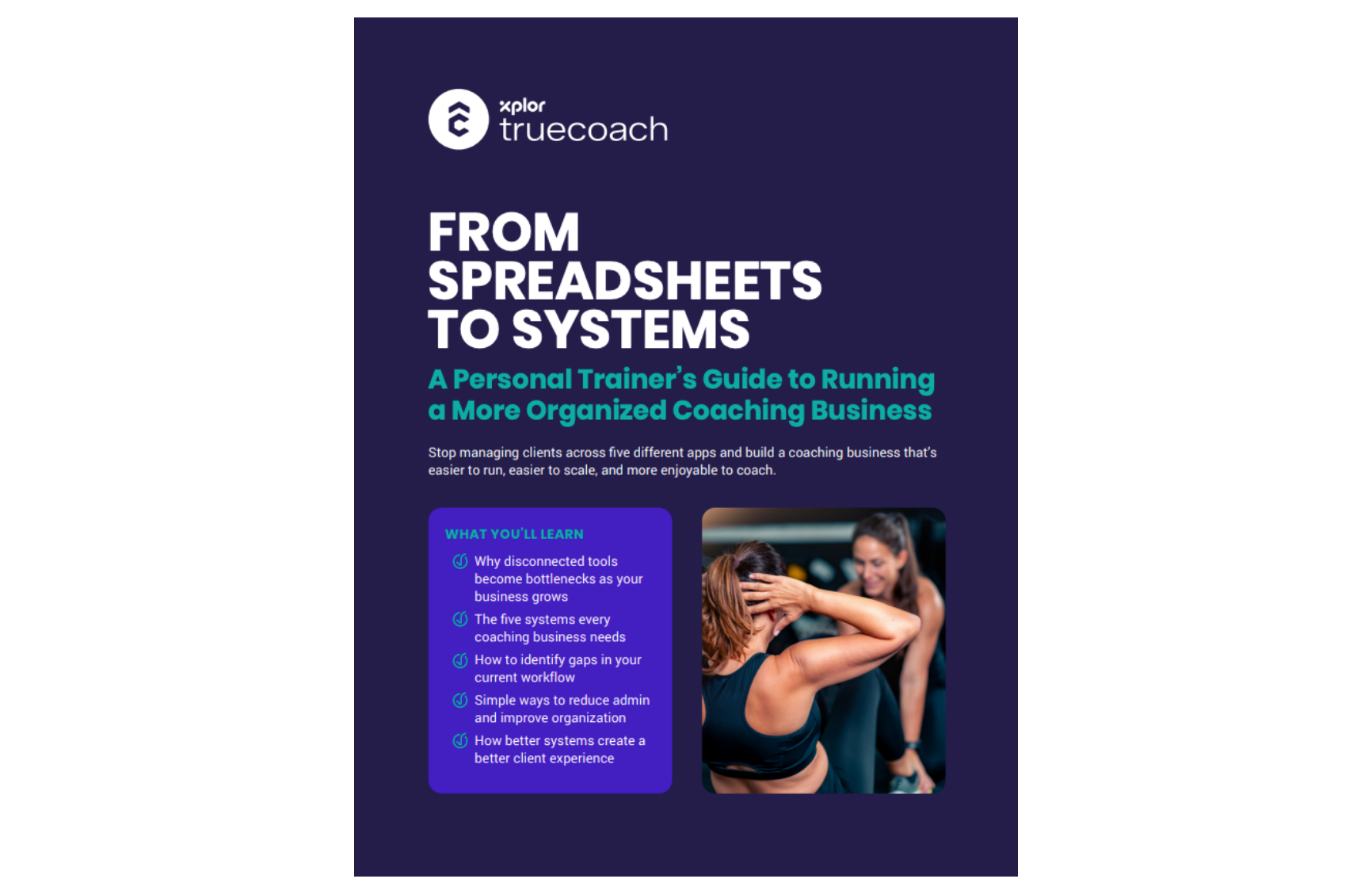
Download the free From Spreadsheet to System: A Personal Trainer’s Guide to Running a More Organized Coaching Business for actionable worksheets, templates, and strategies to help you simplify your operations and build a coaching business that’s organized, scalable, and ready for long-term growth.
And when you’re ready to bring your programming, communication, habits, nutrition, progress tracking, payments, and reporting together, start your free TrueCoach trial.
Sign-Up for Our Newsletter