

Most personal trainers don’t start their fitness business because they are excited about taxes.
You got into coaching to help people move better, feel stronger, and build healthier lives, not to track receipts or figure out write-offs.
But once you start working for yourself, whether that is in-person, online, or hybrid, you also become a business owner. And with that comes a new responsibility. Managing your finances and understanding your taxes.
Here is the upside most trainers do not realize right away.
You are allowed to deduct a wide range of business expenses.
Those deductions can significantly reduce how much you owe.
The problem is that most coaches either do not know what qualifies, do not track things properly, or wait until tax season to figure it out.
That is where things get stressful and expensive.
Keep reading to understand what you can write off, stay organized throughout the year, and approach tax season with confidence.

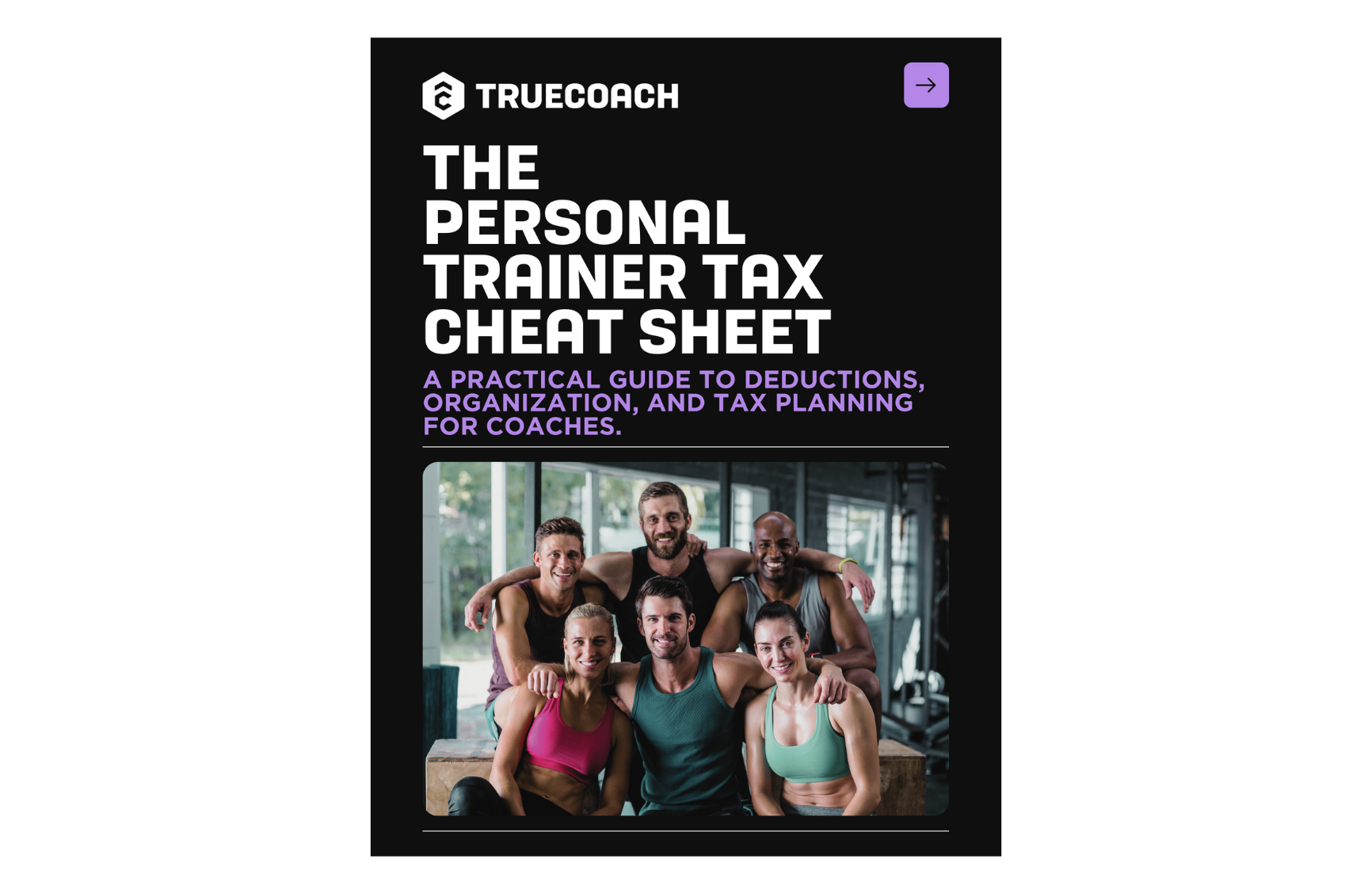
Download the Personal Trainer Tax Cheat Sheet
A quick reference guide to personal trainer taxes, self employed tax tips, deductions, categories, and more that you can use year-round.
Why Taxes Are Different for Personal Trainers
Before you can take advantage of your fitness coach tax deductions, it is important to understand why your tax situation is different from a traditional employee.
Most personal trainers operate in a self-employed capacity. That might look like:
- Freelancing at a gym
- Running your own in-person business
- Coaching clients online
- Operating under an LLC
In all of these cases, you are not just the coach, you are also the business.
That means instead of having taxes automatically withheld from your paycheck, you are responsible for:
- Tracking your income
- Reporting your earnings
- Paying self-employment tax, which includes Social Security and Medicare
- Setting aside tax savings for quarterly or annual payments
Why this matters
This structure can feel overwhelming at first, but as a self employed fitness coach, taxes can come with a major advantage.
You can deduct business expenses to reduce your taxable income.
In simple terms, the more legitimate business expenses you track, the less income you are taxed on.
But this is where many coaches run into problems. They treat their business casually instead of operationally.
No system leads to no tracking, which leads to missed deductions.
That is why creating structure in your business is so important. Using a platform like TrueCoach doesn’t just help with programming and client communication, it also helps you operate like a real business, where services, clients, and deliverables are clearly organized.
When your business is organized, your finances naturally become easier to manage.
The Most Common Tax Deductions for Personal Trainers
Now that you understand how your tax structure works, let us break down the part most trainers care about.
What can you actually write off?
The IRS defines deductible expenses as anything that is:
- Ordinary, meaning common in your industry
- Necessary, meaning helpful for running your business
For personal trainers, this includes far more than just gym equipment.
The key is understanding that anything directly tied to delivering your service, growing your business, or operating professionally may qualify.
Below are the most common and often overlooked tax write offs for personal trainers.
Continuing Education and Certifications
As a coach, your knowledge is your product.
The more you invest in improving your expertise, the better your service becomes and the more valuable your business is.
Because of that, most education-related expenses are considered legitimate business investments.
You can typically deduct:
- Certification programs such as NASM, ISSA, or CSCS
- Workshops and seminars
- Online courses in fitness, nutrition, business, or marketing
- Conferences and industry events
Why this matters
Many trainers hesitate to invest in education because of cost.
When you understand that these are tax-deductible investments, it changes the equation. You are not just spending money, you are reinvesting in your business in a way that can also reduce your taxable income.
Equipment and Training Tools
If you use it to coach clients, demonstrate exercises, or deliver your service, it likely counts.
This is one of the most straightforward deduction categories, but it is also one where trainers often underreport.
Examples include:
- Dumbbells, kettlebells, and barbells
- Resistance bands and mobility tools
- Benches, mats, and racks
- Heart rate monitors or wearables
- Cameras, tripods, and lighting for content creation
For online coaches, this category becomes even more important.
Creating high-quality demonstrations, building exercise libraries, and delivering structured programs are all part of your service. That means the tools you use to create and deliver that content are business expenses.
Many coaches combine this with platforms like TrueCoach to house their workouts and deliver programs efficiently, turning their tools into a complete coaching system. Learn more.
Software and Coaching Platforms
Modern coaching businesses do not run on paper, they run on software.
If you are using tools to manage clients, deliver programs, or streamline operations, those tools are typically deductible.
Common examples include:
- Coaching platforms
- Payment processors such as Stripe or PayPal
- Scheduling tools
- Video platforms such as Zoom or Loom
- CRM or email tools
Why this matters
Software is often one of the biggest recurring expenses for online coaches, but it is also one of the most valuable.
Instead of thinking of it as a cost, think of it as infrastructure.
Platforms like TrueCoach allow you to:
- Deliver workouts
- Communicate with clients
- Track progress
- Manage your coaching business in one place
This not only improves your client experience but also creates cleaner, more organized records, which makes tracking income and expenses much easier at tax time.
Marketing and Business Expenses
If you are trying to grow your business, you are already investing in marketing.
The good news is that most of those expenses are deductible.
This includes:
- Website hosting and domains
- Email marketing platforms
- Branding and logo design
- Paid ads on Instagram, Facebook, or Google
- Content creation tools such as editing software or stock assets
Why this matters
Many trainers overlook marketing as a deductible expense because it does not feel tangible like equipment.
In reality, marketing is what drives growth.
If you are spending money to attract leads, build your brand, or convert clients, that is a business expense.
Home Office Deduction
If you run your coaching business from home, you may qualify for a home office deduction, but this one comes with specific rules.
To qualify:
- The space must be used exclusively for business
- It must be your primary place of work
If you meet those criteria, you may be able to deduct a portion of:
- Rent or mortgage
- Utilities
- Internet
- Office equipment such as desks and lighting
Why this matters
For online coaches especially, your home is your headquarters.
If you are running your entire business from that space, it is worth understanding how to properly account for it.
Taxes for Online Personal Trainers
Online coaching has opened up massive opportunities, but it also adds complexity to your finances.
Unlike traditional trainers, online coaching business taxes often deal with:
- Clients across multiple states or countries
- Digital service delivery
- Multiple payment platforms
- Subscription-based revenue
All of this creates more moving parts to track.
What you need to stay on top of
To run a clean, professional online business, you should consistently track:
- Client payments and revenue
- Software subscriptions
- Marketing spend
- Equipment and production costs
The challenge is not knowing what to track, it is staying consistent.
This is where having a centralized system becomes a major advantage.
Many online coaches use TrueCoach to manage their entire operation, from workouts to communication, which helps create a more structured business. When your operations are centralized, your financial tracking becomes much more manageable.
How Personal Trainers Should Prepare for Tax Season
The biggest mistake trainers make is treating taxes as a once-a-year problem.
In reality, tax success comes down to what you do throughout the year, not just in April.
The more proactive you are, the easier everything becomes.
Simple habits that make a big difference
- Track expenses monthly, not yearly
- Separate personal and business finances
- Save receipts using digital tools if possible
- Use basic accounting software
- Work with an accountant if you can
Why this matters
When you stay consistent, tax season becomes a formality instead of a scramble.
When your business is built on structured systems, everything becomes easier to track, review, and report.
Download the Personal Trainer Tax Cheat Sheet
If you want to simplify all of this and have something you can reference anytime, download the Personal Trainer Tax Cheat Sheet.
Inside, you will get:
- Tax tips for personal trainers
- A breakdown of expenses personal trainers can deduct
- Simple expense categories to follow
- Reminders to help you stay organized year-round
It is designed to be practical and easy to use as you run your business.

Build a More Professional Coaching Business
At its core, this is not just about how personal trainers file taxes. It is about how you run your business.
The more organized your business becomes, the more profitable and scalable it becomes.
When you have:
- Clear systems
- Structured client management
- Organized operations
You do not just make tax season easier, you improve every part of your business.
Platforms like TrueCoach help bring all of this together, allowing you to manage workouts, clients, communication, and progress in one place.
Instead of reacting to your business, you start running it with intention.
That is where real growth happens.
Sign-Up for Our Newsletter